





Homeowner guide · Home remodeling
Two bids for the same remodel rarely list the same things. Here is how to line them up item by item so you are comparing the same scope of work, not just the bottom line.
- 9 minute read
- Updated October 20, 2026
- Sources: CSLB · Business & Professions Code
The short answer
A lower number on a remodeling bid is not automatically a better deal. Before you compare totals, lay the bids side by side and check whether they describe the same scope, materials, payment schedule and change-order terms. California also sets legal minimums for what a home improvement contract must include — a bid that skips them is a red flag on its own, regardless of price.
Put each bid’s line items into one table, mark what is missing, and ask every contractor the same follow-up questions. That is what turns three different-looking proposals into a fair comparison.
Four things to check before you compare totals
- 1
Match the scope first
A bid that is $8,000 lower may simply have left out demolition, permits, or a finish item the others included. Read the scope before the price.
- 2
Know the legal payment limits
California caps the down payment at $1,000 or 10% of the contract, whichever is less, and requires a detailed written payment schedule tied to completed work.
- 3
Change orders must be written
Any change to price or scope has to be documented in a signed change order before the work happens — not verbally agreed and settled later.
- 4
Allowances hide real differences
When a bid lists an “allowance” for cabinets, tile or fixtures, that number is a placeholder, not a guarantee. Compare the allowance amounts, not just the bid totals.
Why two bids on the same project can look so different
Ask three licensed contractors to price the same kitchen remodel and you will usually get three different numbers, and not because anyone is padding or lowballing. Each one is pricing a slightly different mental picture of the job: different assumptions about what is behind the walls, different brands behind an “allowance” line, different crews and different schedules. The gap closes once you force every bid to describe its scope in writing, in the same categories.
That is the purpose of a line-by-line comparison: not to find the cheapest number, but to find out what each number actually buys, so you are choosing a contractor and a plan — not just a price.
What California law requires in the contract
Before you compare how contractors price a job, check whether each bid even meets the state’s baseline for a home improvement contract. This summary was checked against CSLB’s own pages in October 2026; it is a planning guide, not legal advice, so confirm specifics with CSLB or an attorney if a contract looks unusual.
Down payment cap
The down payment on a home improvement contract cannot exceed $1,000 or 10% of the contract price, whichever is less — with no exception for special-order materials.
Source: CSLB: What Is a Contract?
Written, detailed payment schedule
The contract must include a detailed, written payment schedule. Beyond the down payment, payments to the contractor cannot exceed the value of work actually performed at that point.
Source: CSLB Industry Bulletin: Progress Payment Restrictions
Change orders in writing
Any change to the contract price or scope of work must be documented in a written change order, signed by both the homeowner and the contractor before the change is made. It then becomes part of the contract.
Source: CSLB: What Is a Contract?
Required disclosures
The contract must describe the work and materials in detail, name the contractor’s business address and license number, state who is responsible for permits, give a completion date, and include warranty terms in writing — in language that is legible and easy to understand.
Source: CSLB Homeowner Checklists
The line-by-line comparison
Build one table with every bid as a column and these categories as rows. Each card below opens with the follow-up question to ask when a bid is vague on that item.

Demolition & site protection
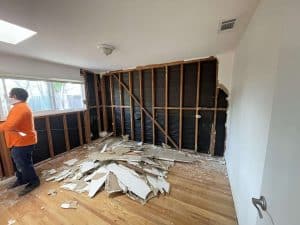
Does the bid price demolition and disposal as its own line, or fold it into “labor”? Ask what happens to the price if demolition reveals rot, old wiring or asbestos-suspect material.

Structural & framing changes
If the project touches load-bearing walls or adds a room, the bid should reference engineered drawings, not just a verbal description of what will “open things up.”

Walls, drywall & insulation
Compare whether each bid includes new insulation where walls are opened, and whether drywall finish level (texture, paint-ready, primed) is spelled out the same way across bids.

Finishes, fixtures & allowances
An “allowance” of $3,000 for cabinets or $40/sq ft for tile is a placeholder number, not a promised product. Ask what brand or grade the allowance assumes, and what happens if you choose something above it.
What to put side by side
| Category | What to look for | Red flag |
|---|---|---|
| Scope of work | A written, itemized description of exactly what will be done, room by room | Vague language like “remodel kitchen per discussion” |
| Materials & allowances | Specific products, brands or grades, or a dollar allowance with the assumed grade stated | An allowance amount with no reference product or grade |
| Permits | Who pulls the permit, and whether the permit cost is included in the price | No mention of who is responsible for permits |
| Payment schedule | A detailed schedule tied to completed work; down payment at or under the legal cap | A large deposit, or payments not tied to milestones |
| Change order terms | A clause requiring written, signed change orders before price or scope changes | A bid that says changes will be “worked out as we go” |
| Timeline | An estimated start date and completion date, or the range that produces | No completion date at all |
| Warranty | Written warranty terms for labor and materials | A verbal promise with nothing in the contract |
| License & insurance | CSLB license number, current status, and proof of insurance | No license number, or a number that does not check out on CSLB’s site |
Reading the payment schedule
The payment schedule is where bids quietly reveal the most. Two contractors can quote the identical total price with very different cash-flow risk to you. When you read a proposed schedule, check three things:
- The down payment is at or under the legal cap — $1,000 or 10% of the contract price, whichever is less.
- Each progress payment is tied to a described, verifiable milestone (for example, “due on completion of rough framing and inspection,” not just a date on the calendar).
- No payment, other than the down payment, asks you to pay more than the value of work completed at that point. That is the rule CSLB’s own bulletin on progress payments describes.
If a bid’s payment schedule front-loads most of the money into the first two payments, ask why, and compare that against how the other bids stage the same project.
Change orders: what to look for
Almost every remodel generates at least one change — a hidden condition behind a wall, a material you decide to upgrade, a scope addition. The contract should already tell you how that gets handled before you ever need one. Look for:
- A clause stating changes must be in a written change order signed by both parties before the work happens.
- Language about how hidden conditions (rot, outdated wiring, framing that does not match plans) are priced and approved.
- Whether the change order references the original payment schedule, so you know when the added cost is due.
A bid that is silent on change orders is not a bid you can fairly compare on price — it is a bid with an unpriced risk built in.
How to run the comparison, step by step
Collect written bids, not verbal quotes
Ask every contractor for the same thing: a written, itemized proposal, not a round number over the phone.
Build one worksheet
Use the categories above as rows and each bid as a column. Leave a cell blank when a bid does not address that item — a blank is information.
Call out every allowance
List the dollar amount and the grade or brand each contractor assumed. A lower total with a lower allowance is not a lower real price.
Check the payment schedule against the legal cap
Confirm the down payment on each bid is at or under $1,000 or 10% of the price, and that progress payments track completed work.
Ask the same follow-up questions of each contractor
Use the blanks in your worksheet as your question list, and ask every bidder the same ones so answers are comparable.
Verify the license before you decide
Check each contractor’s CSLB license number and status directly on CSLB’s site, not just on a flyer or card.
Before-you-sign checklist
Check each item before you choose a bid
Tick items as you confirm them across every bid you are comparing. On this device your progress is remembered, and nothing is sent anywhere.
0 of 10 checked
Questions homeowners ask
Is the cheapest bid usually the best deal?
Not automatically. A lower total often means a different (not necessarily worse) scope — less demolition included, a lower material allowance, or permits priced separately. Compare scope and allowances line by line before you compare totals.
What's the difference between a bid and an estimate?
They are often used loosely, but a bid is typically a firm price for a defined scope, while an estimate is an approximation that can move as details firm up. For a deeper look at the distinction under California practice, see our guide to bids vs. estimates.
How much can a contractor ask for as a down payment?
By California law, the down payment on a home improvement contract cannot exceed $1,000 or 10% of the contract price, whichever is less. There is no special-materials exception to that cap.
What should I do if a bid has no payment schedule at all?
Ask for one before you sign anything. A detailed, written payment schedule is a legal requirement, not an optional nicety. For more on how California law structures contractor payments, see our contractor payment schedule guide.
Should I get a second opinion if two bids are far apart?
It is reasonable to, especially on a large project. A third opinion can confirm whether the gap is scope, materials, or risk pricing. See how to get a second opinion on a construction estimate for how that process works.
Can a contractor change the price after I sign?
Only through a written change order signed by both parties before the change is made. A contract that allows price changes without that process is not meeting the state’s baseline requirements.
Sources and next steps
Where to read the originals yourself:
- CSLB: Learn About Home Improvement Contracts, contract requirements, down payment cap and change-order rule.
- CSLB: Homeowner Checklists, required disclosures before and during a project.
- CSLB Industry Bulletin: Progress Payment Restrictions, rules tying progress payments to completed work (Business & Professions Code §§7159, 7159.5).
- CSLB license check, to verify any contractor’s license and classifications. Quartz Construction & Remodeling’s license number is 1003436.
Facts in this guide were checked against these pages in October 2026. Regulations change, so verify before you rely on them. This is a planning guide, not legal advice.
